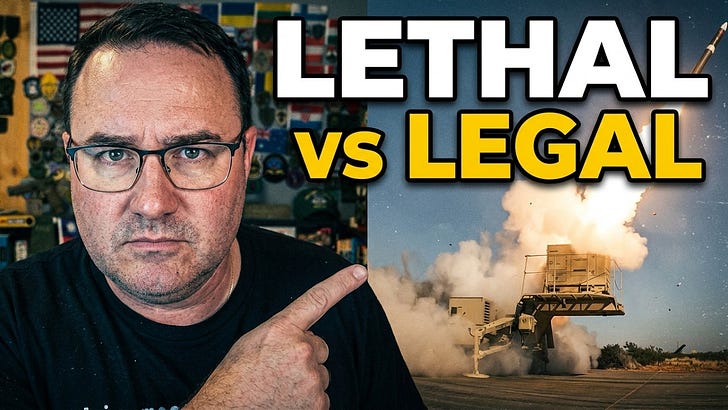
Did Secretary of Defense Pete Hegseth confess to a war crime on camera?
No. But the claim raises a much more important question about how the United States selects targets, protects civilians, and prepares for a large-scale war against an adversary such as Russia or China.
Free members can watch on YouTube. Support the channel for only $5.
In this video, I respond to a viral video from @ohhthatsrich about the defunding of the Civilian Protection Center of Excellence, or CPCE. We look at what the organization actually did, whether its closure contributed to the strike on the Shajareh Tayyebeh girls’ school in Minab, Iran, and why every American military target still goes through legal review.
Short YouTube Videos don’t embed on substack so Rich’s full video is here.
Counterinsurgency operations and Large-Scale Combat Operations differ from each other. And during the wars in Iraq and Afghanistan, the United States could surveil a target for days or weeks and send strike decisions far up the chain of command. In a war against Russia or China, a missile launcher may only be visible for a few minutes—and commanders may have to decide whether to strike even when civilians or protected buildings are nearby.
The generals or today were lieutenants or captains during the Global War on Terror. This means that they have been “primed” to kick legal decisions up the chain of command.
This needs to end, because in a LSCO conflict with Russia or China, targets may present themselves very quickly. Commanders will not have the time to check with Washington if they can engage the target like we did with COIN.
This means that a lot more civilians may be killed in future conflicts, but commanders need to recognize that and weigh the risks of striking a target of opportunity with not striking that target. They also have to know that as long as they are not being reckless, Washington has their back.
CPCE or the Civilian Protection Center of Excellence was the right idea for the the last war. While defunding it may not have been the best choice, the outcome is what was intended: commanders are able to strike targets without Washington interference.
This is a lesson about targeting, legal review, civilian harm mitigation, and why military organizations designed for the last war may not be suited for the next one.