

Canada’s HIMARS Moment
HIMARS would give Canada something it has long lacked: mobile, air-transportable, long-range precision fires for the Arctic, Europe, and the alliance’s next war.

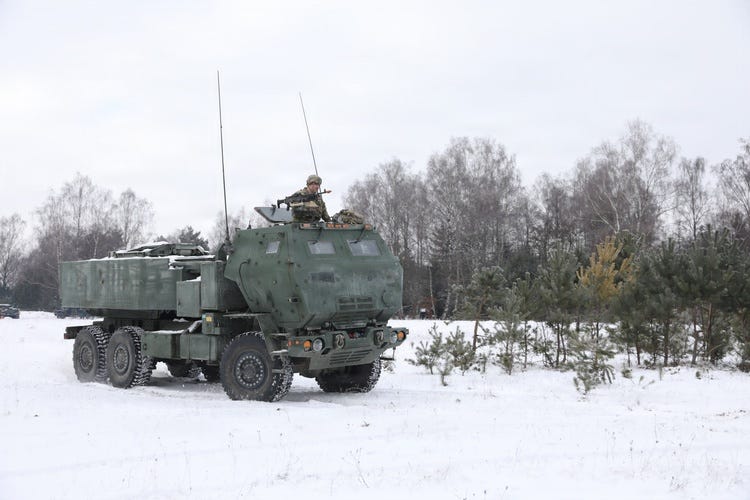
HIMARS is a precision-strike node on wheels: mobile enough to survive, accurate enough to hit high-value targets, and interoperable enough to plug Canada into the long-range fires networks now reshaping NATO defense planning.
Canada appears to be moving from interest to acquisition. In October 2025, the U.S. State Department approved a possible Foreign Military Sale to Canada of 26 M142 High Mobility Artillery Rocket Systems, along with GMLRS rockets, Extended-Range GMLRS rockets, 64 M57 ATACMS missile pods, training, communications gear, spares, and support, for an estimated US$1.75 billion. In April 2026, a U.S. government contract notice listed Canada among the Foreign Military Sales customers included in a US$1.13 billion Lockheed Martin production contract for M142 HIMARS launchers, with work expected to run to April 2028.
For Canada, the significance is not that HIMARS is fashionable because of Ukraine. It is that HIMARS fills a real strategic gap. Canada’s own defense documents say the Long-Range Precision Strike-Land project would let the Canadian Army engage threats at up to 300 kilometers and beyond, a major jump from its current roughly 30-kilometer land-strike range. That changes what Canadian land forces can threaten, how far from danger they can operate, and what Canada can credibly contribute to NATO’s eastern flank.
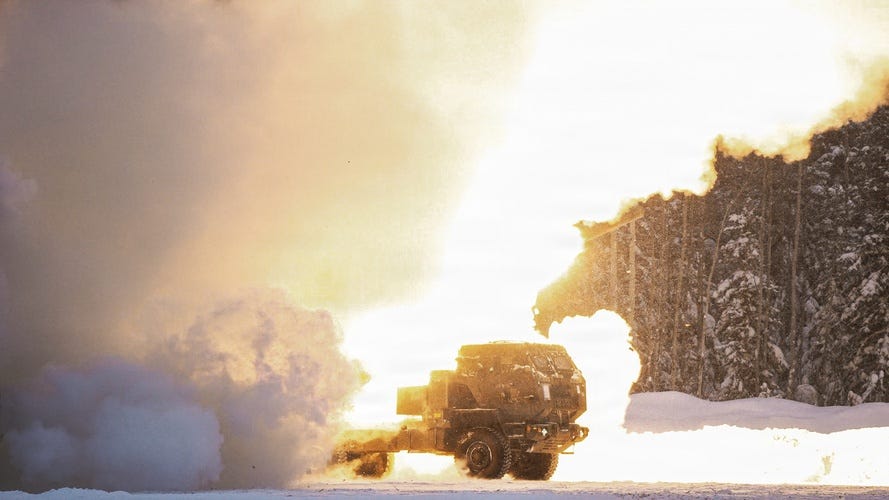
Canada needs reach
Modern war punishes armies that have to get within twenty kilometers of the front. Drones, counter-battery radars, electronic surveillance, loitering munitions, and precision missiles all make massing forces near the front more dangerous. Canada’s Army has recognized this directly. Its Inflection Point 2025 modernization plan says long-range rocket artillery will increase the lethality of deployed forces and continental defense, serve as the “keystone of division deep fires,” add credibility to Canada’s NATO commitments, and enable area denial in the Arctic or Indo-Pacific.
